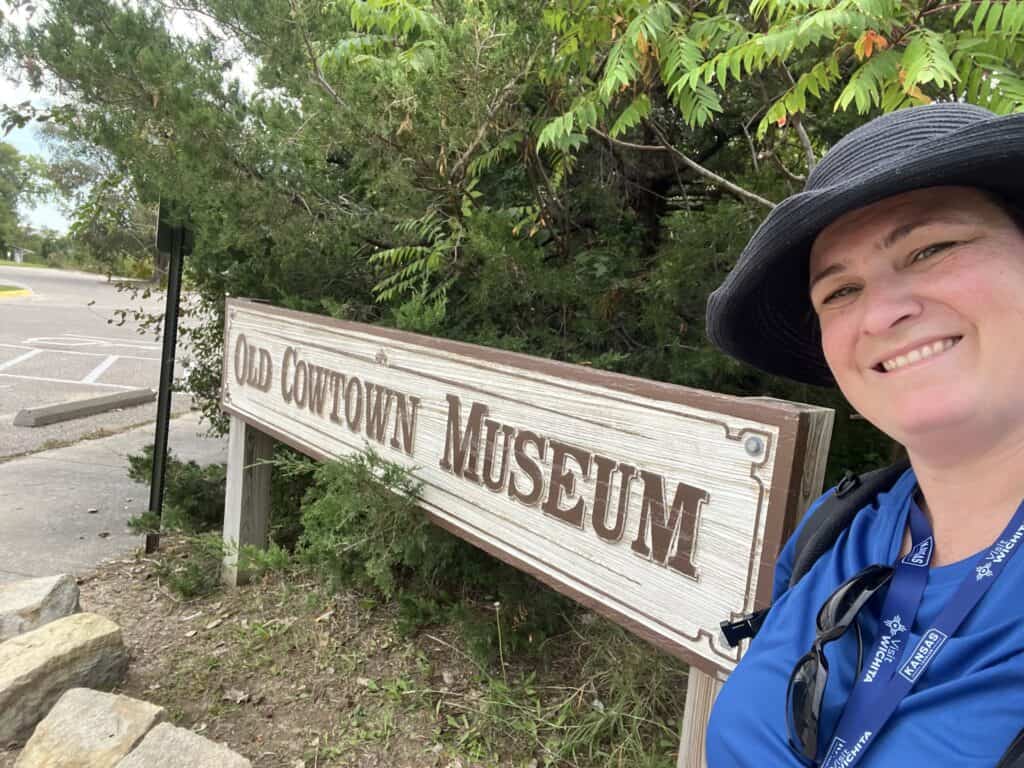
Have you ever dreamed of visiting a real Old West cattle town? You can, at the Old Cowtown Museum in downtown Wichita!
In this post I’ll review what you can see and do at the Old Cowtown Museum. I’ll also include details for making the most of your visit.
Table of Contents

What is the Old Cowtown Museum?
The historic Wichita Cowtown is a living history town. It shows what a frontier settlement would’ve looked like in the late 1800s.
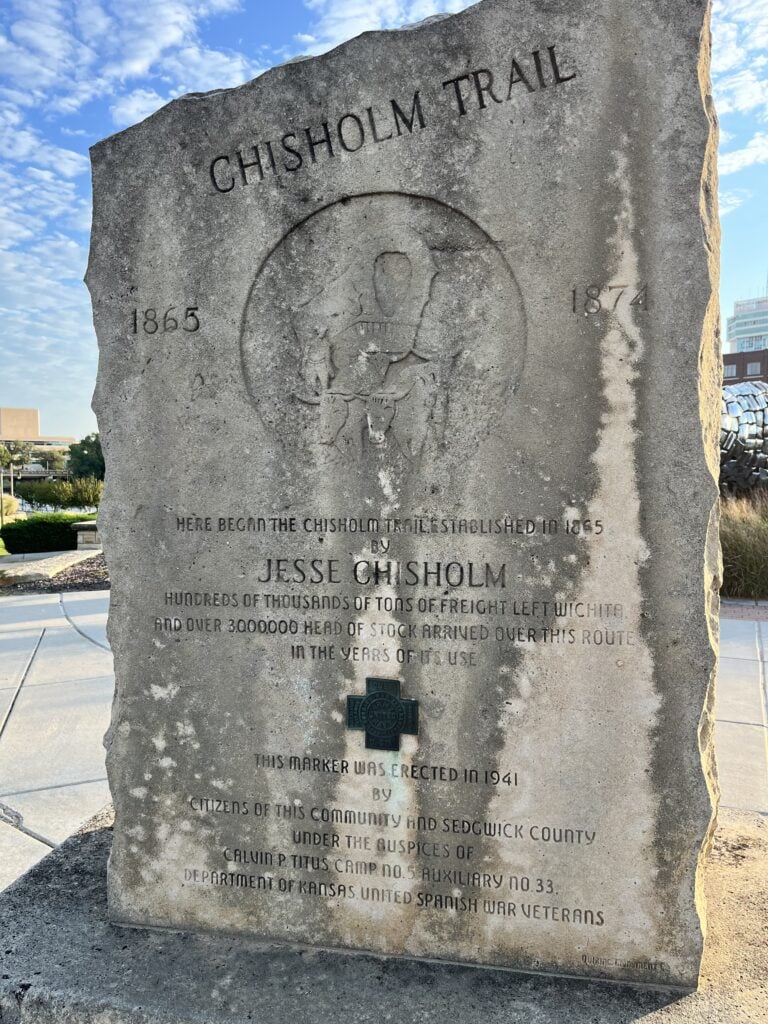
It’s along part of the original Chisholm Trail, which played a key role in the story of Wichita. The Chisholm Trail operated to run cattle to Kansas from Texas during 1872-1876.
The Old Cowtown Museum contains over 50 historic buildings, 27 of which are original, relocated from elsewhere in Kansas. The other buildings are historically accurate recreations.
It’s in the part of Wichita known as Museums on the River, along with five other amazing museums. It’s a great place to learn American history through living history activities and educational programming that run year-round.
Old Cowtown Museum Map

Prefer to watch on YouTube instead of read?
Touring the Old Cowtown Museum
The entrance brings you into the gift shop first. We were introduced to Miss Katie, and she told us a little bit about the history of Midwestern cow towns.
Indigenous history and culture

As we entered the grounds, the first thing we saw was one of the Keepers on Parade statues – it’s gorgeous! It’s one of my favorite pieces because it’s very colorful.
The Keepers on Parade statue honors the native peoples that first lived in Wichita before American resettlement. It’s a smaller replica version of the Keeper of the Plains Statue, which is an icon of downtown Wichita.

As you start walking, the next thing you encounter are some native tipis. There are four that represent each of the original native tribes of the area: the Southern Cheyenne, Arapaho, Comanche, and Kiowa.
Each tipi has a display inside describing the culture of that particular people. The museum is located on a historic site that has been used by nomadic Plains peoples for centuries.
Book your visit to Wichita’s Old Cowtown Museum now!
Cattle boss and cowhand life in Wichita

Just outside of town, we met some living history actors who were demonstrating life as a cattle boss and as a cowhand.
We met a female cattle boss, and learned that there were occasionally female cattle bosses due to being widowed. However it was uncommon to have female cattle bosses and cattle drovers.
Wichita’s wild past

Cattle drovers, cowhands and cowboys weren’t really welcome in polite society. They weren’t welcome in the nicer parts of town either, so the Delano district in downtown Wichita was their designated area.
The Delano district was wild, rowdy and rough. It was the only spot in town where they could participate in illicit activities.
Branding and roping

Next, one of the living history demonstrators was there to show us how they branded cattle. Of course, we didn’t use live cattle! She had to do it on pieces of wood instead.
I got to actually use a hot poker cattle brand to create my own piece of wood with a cattle brand on it. That was really cool!
You could see the smoke rising. You had to wiggle the brand around to make sure it marked the wood properly.

She also taught us how to use a lariat and how we would rope a calf if we were cowhands. That was much harder than it looks! But it was a really cool experience to be able to try that out.
Walking along main street
We walked past several historic buildings including the general store, a lawyer’s office, a church, and a barber shop. We didn’t have time to visit all of them, sadly, but it was fun to peek in the windows as we moved along.

Wichita City Eagle print shop
Next we stepped into the Wichita City Eagle print shop where they printed the local newspaper. I was shocked to see that the newspaper had such tiny print!
The reason for the tiny print was, the bigger the print was, the less could fit, so the more expensive it was to print the newspaper. They wanted to try and get everything onto a single sheet.

The living history actor explained how expensive it was to print a newspaper in that time period. So print shops weren’t necessarily making a ton of money on the newspaper itself. But they started being used to print other things like invitations, or calling cards to leave with someone when you visited.
I got to print my own souvenir card. That was really neat to see the process of winding it down to make a print, and then it would come back up. The ink takes about 20 or 25 minutes to fully dry, so we had to hold our cards carefully while walking around town.

Seamstress shop
We also stopped at a seamstress shop, and that was fascinating to see. I got to sew on one of the foot pedal Singer machines – the original kind that they had before electric machines.
I was actually kind of good at it because I’m a quilter, so I know something about how to use a machine.
All of it was foot powered, and you could only stitch in one direction. So it was a very time-intensive and labor-intensive process.

It was also super interesting to find out why women wore the huge bustles and hoop skirts. Miss Katie showed us all the layers, and she had five or six layers under her hoop skirt!
And really it was just vanity! It was fashionable to show that you were rich enough to be able to afford all of that fabric. The day we visited it was 85 degrees and Miss Katie was sweating in all that clothing.

I can’t imagine wearing that many layers of clothing just to show someone that I was fashionable. But Midwestern women wanted to wear it all because it showed they were well off.
Blacksmith shop
Our next stop was the blacksmith shop to see the blacksmith at work. In the late 1800s a blacksmith was where you would get all your tools made and cared for. It was where you’d go if your plow got broken.

Many blacksmiths started to specialize. So there were wheelwrights who would specialize in making wheels. There also might be a silversmith who would specialize in silver stuff.
There were smiths who would specialize in horseshoes and they would be farriers – they would serve as vets too.
Blacksmithing was a really important job for centuries, all the way up until the modern era. Nowadays a lot of it’s done by machine.
A stop at the saloon

As we continued through town, we passed more buildings like the grain elevator, the livery stable, the City Marshal office and the Depot. We finished up at the saloon.
We got to have authentic ice cold sarsaparilla, which was delicious. It’s kind of like root beer, but way better.

Reserve your tickets to Wichita’s Old Cowtown Museum now!
What else is at the Old Cowtown Museum?
There’s also livestock and farm animals on hand that you can pet and meet. We passed a schoolhouse that has books and slates that would’ve been used in the 1800s. There were some fun kids games outside that we got to try.
I wanted to visit the residential street and the functioning period farm, but we only had about an hour for our visit. You could easily spend half a day exploring the town.

Most days there’s a staged shootout in the downtown area on Main Street. We didn’t get to see that, but if you’re planning on visiting, check the website for times and other special events. For example, Old Cowtown Museum hosts a Victorian Christmas, and while I was there they were preparing for their 1880s country fair event.
Visiting the Old Cowtown Museum was an amazing experience. It allows you to get a feel for what life would’ve been like in Wichita between 1865 and 1880.
I highly recommend stopping there if you’re visiting Wichita. I can’t wait to go back with my kids and show them what a cool place the Old Cowtown Museum is!
You may also enjoy these posts:
- Hotel at Old Town Wichita: Review
- One Day in Wichita’s Wild West: itinerary
- Stay at the Circle S Ranch in Lawrence, Kansas
- Museum of the Mountain Man (Wyoming)
- Best gifts for cowboys
©️ Copyright Jennifer D. Warren 2025.